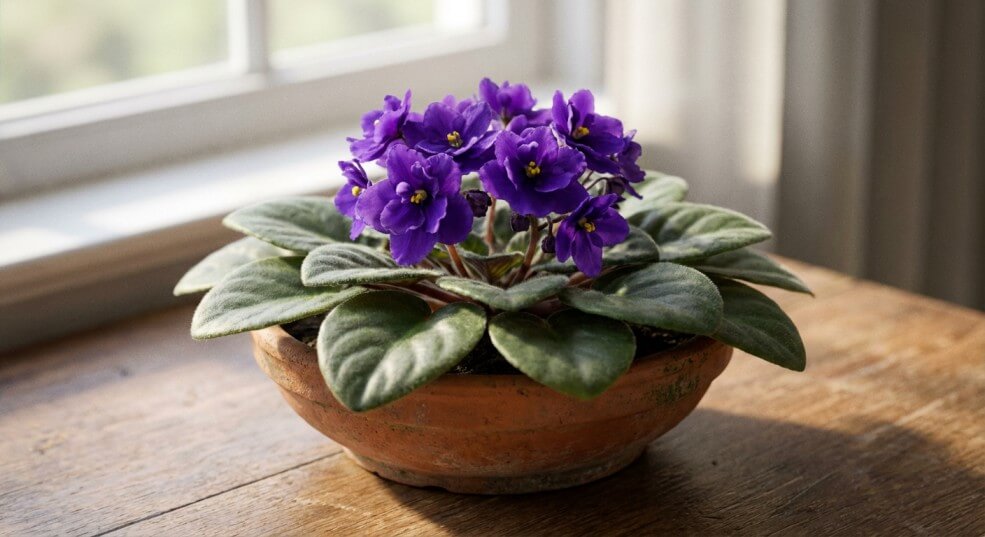
African violets (Saintpaulia ionantha and related hybrids) are among the most genetically refined ornamental houseplants in cultivation.
Decades of selective breeding have optimized them for compact growth, prolific flowering, and indoor conditions.
However, this refinement has also made them less tolerant of environmental errors, particularly those involving the root zone.
Among all cultural variables—light, fertilizer, humidity, and temperature—pot selection exerts the most direct and long-lasting influence on African violet performance.
The pot is not merely a container; it is a micro-ecosystem that governs oxygen diffusion, moisture gradients, microbial balance, and thermal stability.
This guide examines African violet pots from a plant-physiology and soil-physics perspective, explaining not just what works, but why it works.
Why African Violet Pots Require a Different Design Philosophy Than Standard Houseplants
Most common houseplants evolved in environments where roots penetrate deep mineral soils or thick organic layers. African violets did not.
Native Habitat Context (Critical for Understanding Pot Choice)
African violets originate from the Usambara Mountains of Tanzania and Kenya, where they grow:
- In shaded rock crevices
- On moss-covered slopes
- In thin layers of decomposing organic matter
These environments share three defining features:
- Shallow rooting depth
- Constant but well-aerated moisture
- High oxygen availability
In nature, excess water drains instantly through rock fissures, while humidity keeps roots from desiccating. Pots must replicate these conditions artificially.
Informational Quote:
“African violets are adapted to shallow, oxygen-rich substrates—conditions rarely found in conventional deep containers.”
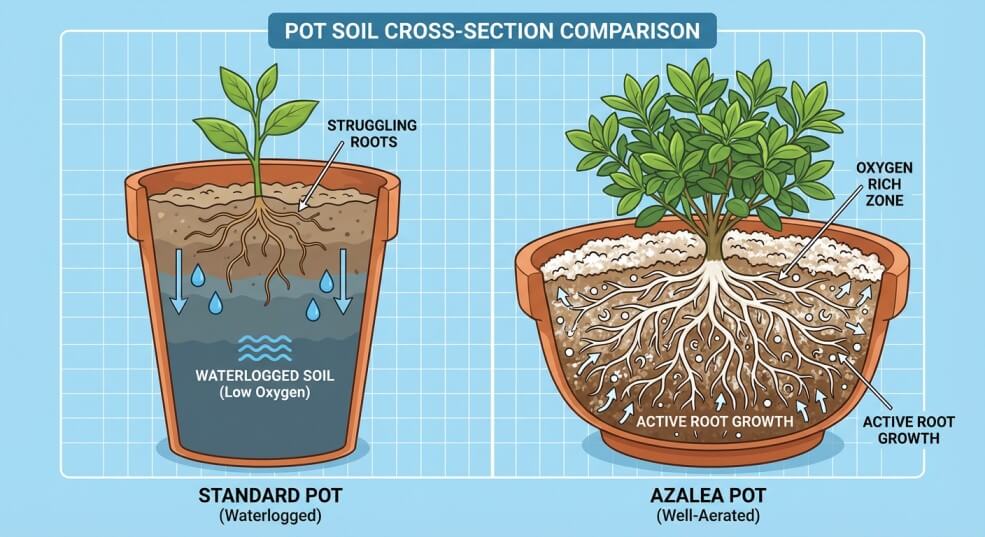
Standard houseplant pots fail because they:
- Create deep, stagnant moisture zones
- Reduce oxygen diffusion at lower depths
- Encourage excessive root expansion at the expense of flowering
You May Also Like: Best African Violet Potting Mix: Guide and Ratios
African Violet Root Architecture: Fine Roots, High Oxygen Demand, and Low Error Tolerance
Structural Characteristics of African Violet Roots
African violet roots are:
- Extremely fine and fibrous
- Largely confined to the upper substrate layer
- Poorly adapted to hypoxic (low-oxygen) conditions
Unlike woody plants, they lack thick structural roots that tolerate saturation.
Root Respiration and Oxygen Diffusion (Why Depth Matters)
Roots respire continuously. Oxygen moves through soil via air-filled pore spaces, not water. When these pores fill with water, oxygen diffusion drops sharply.
Research in soil physics demonstrates:
- Oxygen diffusion in saturated soil can drop by 80–95%
- Fine-root species experience damage within 48–72 hours
- Recovery is slow and often incomplete
Diagram (Conceptual Description)
Imagine a vertical pot cross-section:
- Top 2 inches: alternating air and water pores (healthy)
- Bottom half: permanently saturated zone (root-dead zone)
African violet roots simply do not colonize that lower zone, turning much of a deep pot into wasted, harmful space.
Pot Size as a Biological Signal: Why Smaller Pots Trigger Blooming
African violets respond to pot size as a developmental signal.
The Root-to-Shoot Resource Allocation Model
Plants allocate energy between:
- Vegetative growth (roots and leaves)
- Reproductive growth (flowers)
When roots have excess space:
- Energy flows into root expansion
- Flower initiation is delayed
When roots encounter moderate restriction:
- Root expansion slows
- Hormonal balance shifts toward flowering
This is why African violets bloom more reliably when slightly root-bound.
“For African violets, mild root restriction is not stress—it is a flowering trigger.”
African Violet Pot Size Guidelines (Expanded and Evidence-Based)
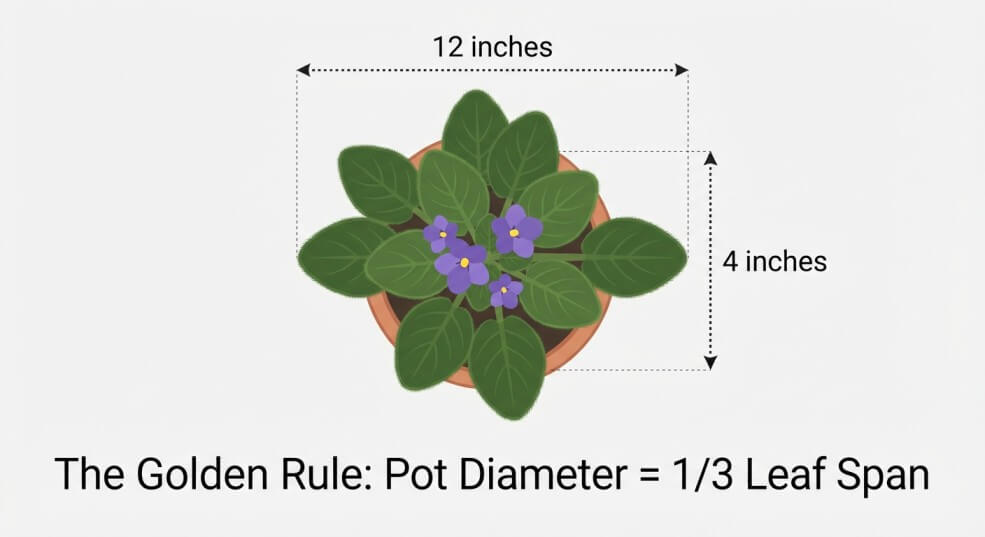
The 30–35% Rule Explained
The commonly cited guideline—pot diameter equals one-third of leaf span—is not arbitrary. It reflects:
- Optimal root-to-shoot ratio
- Adequate oxygen diffusion
- Controlled moisture retention
Expanded Pot Size & Depth Table
| Violet Type | Leaf Span | Pot Diameter | Max Pot Depth | Bloom Reliability |
| Miniature | 4–6 in | 2–2.25 in | 2 in | Very high |
| Semi-mini | 6–8 in | 2.5–3 in | 2.5 in | High |
| Standard | 8–12 in | 4–5 in | 3 in | High |
| Large Standard | 12–15 in | 5–6 in | 3.5 in | Moderate |
| Trailers | Variable | Wide & shallow | 2.5–3 in | High if shallow |
Depth Is as Important as Diameter
Many growers focus on width but ignore depth. Depth beyond 3–3.5 inches increases:
- Water retention time
- Root hypoxia risk
- Salt accumulation
Pot Material Science: Moisture, Temperature, and Oxygen Interactions
Pot material influences three critical variables:
- Evaporation rate
- Root-zone temperature
- Gas exchange
Material Performance Matrix (Expanded)
| Material | Evaporation Rate | Oxygen Exchange | Thermal Stability | Risk Profile |
| Plastic | Low | Low–Medium | High | Overwatering |
| Terracotta | High | High | Low | Underwatering |
| Glazed ceramic | Medium | Low | Medium | Hidden saturation |
| Double-pot systems | Controlled | Medium | Medium | Mismanagement |
Plastic Pots: Moisture Stability Over Airflow
Plastic reduces evaporation by 30–50% compared to clay. This makes it suitable for:
- Dry indoor environments
- Growers with irregular watering habits
However, plastic pots magnify soil mistakes. Dense soil + plastic = oxygen starvation.
Terracotta Pots: Gas Exchange at the Cost of Moisture Loss
Clay pots:
- Increase evaporation through micropores
- Improve oxygen diffusion
- Lower fungal pressure
But they:
- Dry rapidly in warm rooms
- Cause temperature swings
- Require frequent monitoring
They are best for humid climates or experienced growers.
Drainage as an Oxygen Management System
Drainage holes are not primarily about water exit—they allow air entry.
Drainage Hole Physics
When water exits a pot:
- Negative pressure draws air inward
- Oxygen replenishes root zones
- Carbon dioxide escapes
Without adequate drainage:
- Roots suffocate even if soil “looks moist”
Optimal Drainage Specifications
| Feature | Optimal Range |
| Hole diameter | 6–10 mm |
| Number of holes | 1–3 |
| Saucer depth | ≤ 1 cm |
| Standing water time | < 30 min |
Self-Watering Pots: Capillary Action, Wicking Limits, and Salt Dynamics
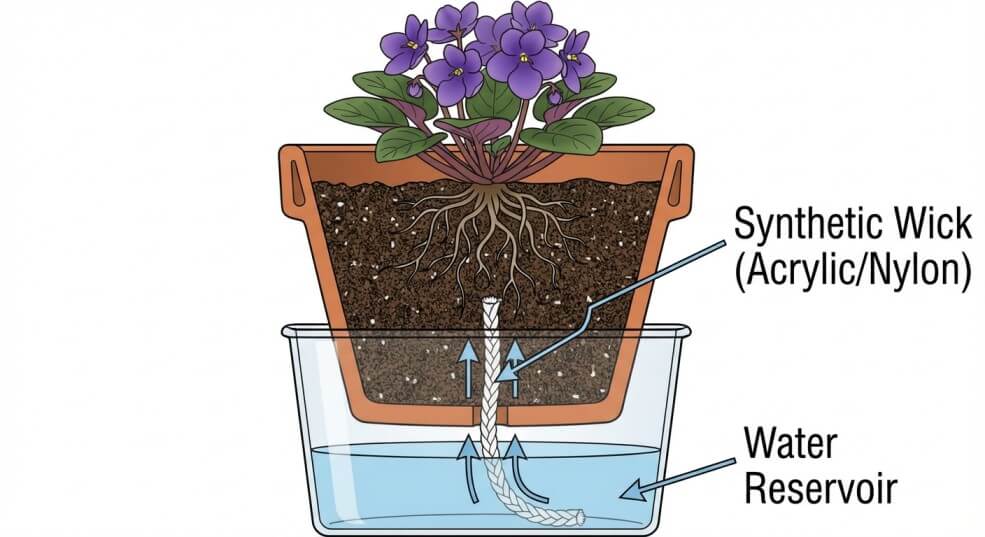
Self-watering systems rely on capillary rise, governed by pore size.
Why Soil Structure Matters
Capillary action works only if:
- Soil pores are small but continuous
- Air space remains ≥ 30%
- Salts do not clog pores
Failure Mode Case Study
A common scenario:
- Dense peat soil collapses
- Wick stays saturated
- Oxygen diffusion drops
- Roots rot from below upward
Self-watering pots demand better soil discipline, not less.
Environmental Variables That Must Influence Pot Choice
Humidity
- Low humidity (<40%) → slower evaporation preferred
- High humidity (>60%) → faster drying needed
Temperature
- Cool rooms (<18°C): avoid clay
- Warm rooms (>24°C): avoid plastic unless soil is very airy
Light Intensity
Higher light increases:
- Transpiration
- Water uptake
- Evaporation demand
Pot choice must adjust accordingly.
Common Potting Errors and Their Physiological Consequences
| Error | Root Impact | Visible Symptom |
| Deep pots | Hypoxia | Leaf yellowing |
| Oversizing | Delayed flowering | Large leaves, no blooms |
| No drainage | Root rot | Sudden collapse |
| Dirty pots | Pathogens | Chronic decline |
| Decorative pots only | Waterlogging | Wilting despite wet soil |
Repotting: Pot Renewal vs Pot Upsizing
African violets benefit from frequent repotting, but not frequent upsizing.
Best Practice
- Repot every 6–9 months
- Replace soil completely
- Reuse pot size unless roots are severely congested
Why Repotting Works
- Restores pore structure
- Removes salt buildup
- Reintroduces oxygen pathways
Case Study: Identical Plants, Different Pots
Setup
- Two identical African violets
- Same light, fertilizer, and soil
- One in a 6-inch deep pot
- One in a 4-inch shallow pot
Results after 4 months
- Deep pot: lush leaves, zero blooms
- Shallow pot: moderate leaves, continuous flowering
Conclusion
Pot geometry alone altered flowering behavior.
Frequently Asked Questions (Expanded)
Do African violets need special pots?
They need specific proportions, not specialty branding.
Why do shallow pots work better?
They preserve oxygen availability across the entire root zone.
Can African violets grow in decorative containers?
Only if drainage and airflow are maintained via inner pots.
Final Synthesis: African Violet Pots as Engineered Root Environments
African violet pots function as:
- Oxygen regulators
- Moisture buffers
- Thermal stabilizers
- Developmental signals
When pot size, depth, material, and drainage align with African violet physiology, the plant performs with predictable vigor and bloom reliability.
This is not guesswork—it is applied plant science.