Quick Explain
- The best fertilizers for garlic is aged compost or well-rotted manure worked into the soil before planting, since garlic stays in the ground for up to nine months and needs a steady nutrient supply the whole time.
- For early spring growth, blood meal (12-0-0) is the standard organic nitrogen source, applied as a side-dress once shoots reach 3-4 inches tall.
- Once bulbs start swelling, switch to a potassium-focused fertilizer like sulfate of potash to support bulb size and storage life.
- Garlic needs more sulfur than most vegetables because sulfur drives allicin production, the compound behind its flavor and smell – if soil sulfur drops below 10-15 ppm, plants show pale, yellowing leaves (Groeat, 2025).
- Stop all fertilizing by early July (or about 3-4 weeks before harvest) – late nitrogen causes soft necks and bulbs that rot in storage (LifeTips Alibaba, 2026).
What to Look for in a Garlic Fertilizer
Garlic is a heavy feeder with a growing season that can run 8-9 months, so the right fertilizer changes depending on the stage of growth. Before picking a product, check these five factors.
| Criterion | Why It Matters |
| NPK ratio and stage match | Garlic needs high nitrogen early for leaf growth, then more potassium as bulbs form |
| Sulfur content | Sulfur builds allicin, the compound responsible for garlic’s pungent flavor |
| Release speed | Slow-release options feed for weeks; liquid feeds act fast but need repeat applications |
| Organic vs. synthetic | Organic options build soil biology over time; synthetics give precise, fast-acting nutrients |
| Application method | Granular fertilizers are worked into soil or side-dressed; liquids are watered in or sprayed |
How Garlic’s Nutrient Needs Change Through the Growing Season
Garlic’s nutrient demands shift in three clear phases: root and leaf establishment, vegetative growth, and bulb formation.
Matching fertilizer to each phase is the single biggest factor in bulb size, according to research from the University of California Agriculture and Natural Resources, which found garlic needs higher nitrogen during leaf development but reduced nitrogen once bulbing starts to avoid trading bulb size for excess foliage (UC ANR, 2023).
| Growth Stage | Nutrient Focus | Suggested NPK Direction | Fertilizer Type |
| Planting (fall) | Phosphorus, organic matter, root establishment | Balanced to P-heavy (10-10-10 or bone meal 3-15-0) | Compost, manure, bone meal |
| Early spring (shoots emerge) | Nitrogen for leaf growth | High N (12-0-0 to 16-6-4) | Blood meal, fish emulsion |
| Mid-spring (active leaf growth, scapes form) | Balanced N-P-K, sulfur | Balanced (10-10-10) | Granular all-purpose, compost tea |
| Bulb initiation and swelling | Potassium, reduced nitrogen | Low N, high K (5-10-10 or sulfate of potash) | Sulfate of potash, kelp meal |
| Pre-harvest (last 3-4 weeks) | None – taper off | No additional feeding | None |
Each leaf a garlic plant grows becomes a wrapper layer on the bulb below, so nitrogen early in the season has a direct effect on how many protective layers the bulb has at harvest (HTEC Farming, 2026). That’s why timing matters more than the total amount applied.
1. Aged Compost or Composted Manure – Best Foundation Fertilizer

Compost and well-rotted manure are the starting point for any garlic bed. Mix 2-3 inches into the top 6-8 inches of soil before planting in fall (RASNetwork, 2025).
Key features:
- Releases nutrients slowly over the entire 8-9 month growing season
- Improves soil structure, drainage, and water retention
- Adds organic matter that feeds beneficial soil microbes
NPK: Variable, typically low (around 1-1-1 to 2-1-1 depending on source) Cost: Low if homemade; $5-15 per 40 lb bag for bagged compost or manure Best for: Every garlic grower, as a pre-planting soil amendment
Always use manure that has composted for at least six months. Fresh manure can burn cloves and introduce pathogens into the bed (Epic Gardening, 2025).
2. Blood Meal – Best for Early Nitrogen Boost

Blood meal is a fast-acting organic nitrogen source with an NPK around 12-0-0 (RASNetwork, 2025). It’s the go-to side-dress once garlic shoots are actively growing.
Key features:
- Delivers nitrogen within days, supporting leaf growth that fuels bulb size later
- Apply 1-2 tablespoons per square foot once shoots reach 3-4 inches tall
- Brands like Espoma, Down to Earth, and Jobe’s all offer OMRI-listed blood meal (ReSprout, 2024)
NPK: 12-0-0 Cost: $10-20 for a 3-4 lb bag Best for: Gardeners who need a quick green-up in early spring
Use blood meal early in the season only. Applying it after bulbs start forming pushes leaf growth at the expense of bulb size.
3. Bone Meal – Best for Root and Bulb Development
Bone meal supplies phosphorus, the nutrient responsible for root strength and bulb formation. Espoma’s organic bone meal is rated 4-12-0, while Dr. Earth’s version runs closer to 3-15-0 (Espoma/Walmart product data, 2025).
Key features:
- Best worked into the soil at planting time, not as a later side-dress
- Supports the root system garlic builds during fall and winter dormancy
- Slow to break down, so it keeps feeding through spring
NPK: 3-15-0 to 4-12-0 Cost: $10-25 for a 4 lb bag Best for: Fall planting, especially in phosphorus-poor soils (confirm with a soil test first)
4. Espoma Garden-tone (3-4-4) – Best All-Purpose Organic Granular
Garden-tone is a slow-release, all-purpose organic blend formulated for vegetable beds, with an NPK of 3-4-4 (Home Depot product listing, 2024).
Key features:
- Balanced ratio works at planting and as a light spring top-dress
- Slow-release formula lowers the risk of burning young roots
- Contains bio-tone microbes that support soil biology
NPK: 3-4-4 Cost: Around $12-30 depending on bag size (8-27 lb) Best for: Gardeners who want one product to cover most of the season
5. Fish Emulsion – Best Liquid Feed for Fast Uptake
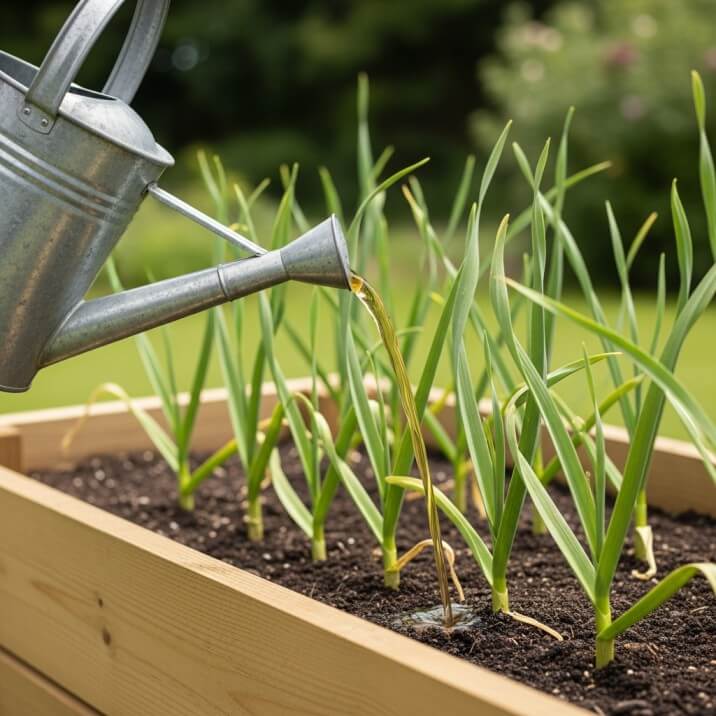
Fish emulsion is a liquid fertilizer, typically labeled around 5-1-1 (RASNetwork, 2025), that gives garlic an immediate nitrogen lift.
Key features:
- Apply at label rate every 2-3 weeks during active spring growth (GardenWired, 2025)
- Acts faster than granular options because nutrients are already water-soluble
- Often paired with kelp for a combined nitrogen and trace-mineral feed
NPK: Approximately 5-1-1 Cost: $10-20 per 32 oz concentrate (makes multiple gallons diluted) Best for: Correcting yellowing leaves quickly or feeding container garlic
The main drawback: liquid feeds wash through soil faster than granular ones, so they need more frequent applications (HTEC Farming, 2026).
6. Kelp Meal or Liquid Seaweed – Best for Stress Tolerance and Bulb Quality
Kelp meal won’t replace nitrogen fertilizer, but it complements one by improving bulb quality and helping garlic handle cold and drought stress (RASNetwork, 2025).
Key features:
- Work dry kelp meal into soil before planting at about 1 lb per 100 square feet
- Use liquid seaweed as a foliar spray every 2-3 weeks during spring growth
- Soaking cloves in diluted kelp solution for 12 hours before planting can jump-start root growth (RASNetwork, 2025)
NPK: Low (often 1-0-2 to 1-0-4) Cost: $15-25 per bag or concentrate bottle Best for: Adding to any feeding program as a supplement, not a primary fertilizer
7. Sulfate of Potash – Best for Bulb Sizing and Storage

As bulbs start to swell, garlic needs more potassium and less nitrogen. Sulfate of potash (SOP), with an NPK around 0-0-50, is the standard choice for this stage (AgriFarming, 2023).
Key features:
- Switch to SOP once you see bulb swelling at the base of the plant
- Potassium supports disease resistance and helps bulbs cure and store well
- Contains sulfur as a bonus, supporting flavor development
NPK: 0-0-50 (with sulfur) Cost: $15-30 per 4-5 lb bag Best for: The bulb-swelling stage, 4-6 weeks before harvest
8. Gypsum or Ammonium Sulfate – Best for Sulfur and Flavor
Sulfur is often the most overlooked nutrient in garlic fertilization, but it’s directly tied to flavor strength. Without enough sulfur, garlic tastes noticeably weaker (HTEC Farming, 2026).
Key features:
- If a soil test shows sulfur below 10 ppm, side-dress with gypsum (calcium sulfate) at about 1/2 cup per 10 linear feet in early spring (LifeTips Alibaba, 2026)
- Ammonium sulfate supplies both nitrogen and sulfur in one application
- Gypsum also adds calcium, which supports cell structure in developing bulbs
NPK: 0-0-0 for gypsum (21-0-0 for ammonium sulfate, plus sulfur) Cost: $10-20 per 5-10 lb bag Best for: Soils confirmed low in sulfur via a soil test, or gardens where garlic has tasted mild in past seasons
9. Balanced 10-10-10 Granular or Slow-Release Synthetic – Best Convenient Synthetic Option
A balanced synthetic fertilizer, such as 10-10-10, gives a precise, predictable nutrient mix and is a reasonable choice when a soil test shows a clear deficiency across the board (GardenWired, 2025).
Key features:
- Apply at planting per label rate, then side-dress with a high-nitrogen product once shoots reach 6 inches
- Slow-release coated versions (such as Osmocote) feed for weeks with fewer applications and lower burn risk
- Faster-acting water-soluble versions (such as Miracle-Gro) work well for correcting deficiencies but need reapplication every 1-2 weeks
NPK: 10-10-10 (balanced) or product-specific for slow-release blends Cost: $10-25 depending on bag size and brand Best for: Gardeners who want precise control over nutrient ratios, or larger plots where organic amendments would be costly
Watch for salt buildup and runoff with repeated synthetic applications, and avoid placing granules directly against stems (GardenWired, 2025).
10. Keene Garlic’s Organic Garlic Fertilizer (5-2-2) – Best Garlic-Specific Formula
There aren’t many fertilizers formulated specifically for garlic, but Keene Garlic’s Organic Garlic Fertilizer is one, rated 5-2-2 (ReSprout, 2024).
Key features:
- Apply before planting or in spring at a rate of 2 ounces per square foot
- Pre-balanced specifically for allium crops, removing the guesswork of mixing your own blend
- Organic certification suits gardeners avoiding synthetic inputs
NPK: 5-2-2 Cost: Typically $15-25 per bag, varies by retailer Best for: Gardeners who want a single garlic-specific product without building a custom feeding program
Comparison Table: Garlic Fertilizers at a Glance
| Fertilizer | Best For | NPK | Type | When to Apply |
| Compost/aged manure | Foundation/soil building | Variable, low | Organic | Before planting (fall) |
| Blood meal | Early nitrogen boost | 12-0-0 | Organic | Early spring, shoots 3-4 in. |
| Bone meal | Root/bulb development | 3-15-0 to 4-12-0 | Organic | At planting |
| Espoma Garden-tone | All-purpose feeding | 3-4-4 | Organic | Planting + light spring top-dress |
| Fish emulsion | Fast-acting nitrogen | ~5-1-1 | Organic liquid | Every 2-3 weeks, spring |
| Kelp meal/liquid seaweed | Stress tolerance, quality | Low (varies) | Organic | Pre-planting + spring foliar |
| Sulfate of potash | Bulb sizing/storage | 0-0-50 | Mineral | Bulb swelling stage |
| Gypsum/ammonium sulfate | Sulfur/flavor | 0-0-0 / 21-0-0 | Mineral | Early spring if soil test confirms need |
| Balanced 10-10-10/slow-release | Convenience, precision | 10-10-10 (varies) | Synthetic | Planting + side-dress |
| Keene Garlic Organic Fertilizer | Garlic-specific blend | 5-2-2 | Organic | Planting or spring |
A Fertilizing Schedule for Fall-Planted Garlic
Most home gardeners plant garlic in fall for a summer harvest. Here’s how to time fertilizer applications across that cycle.
| Timing | What to Apply | Why |
| At planting (fall) | Compost or aged manure, plus bone meal | Builds soil structure and supplies phosphorus for fall root growth |
| Early spring (shoots emerge) | Blood meal or fish emulsion | Drives the leaf growth that determines bulb wrapper layers |
| 3-4 weeks later | Balanced fertilizer (10-10-10) or compost tea | Supports continued leaf growth alongside early bulb formation (Optimal Fertilizing Schedule, 2026) |
| Bulb initiation/swelling | Sulfate of potash or 5-10-10 | Shifts the plant’s energy toward bulb size rather than more leaves |
| 3-4 weeks before harvest | Nothing | Lets bulbs finish sizing and cure properly for storage |
A consistent nitrogen schedule matters: garlic responds best to nitrogen split into smaller doses every 2-4 weeks during active growth rather than one large application (Wikifarmer, 2023).
Spring-Planted Garlic: What Changes
If you missed fall planting and put cloves in during early spring instead, fertilizing becomes more urgent. Spring-planted garlic hasn’t had a fall and winter to establish roots, so it starts the season at a disadvantage (ReSprout, 2024).
For spring planting, apply a balanced or slightly nitrogen-heavy fertilizer (such as 10-10-10 or blood meal) at planting time rather than waiting for shoots to emerge.
Then follow the same mid-season and bulb-swelling steps as fall-planted garlic, just compressed into a shorter window.
In warm climates (USDA zones 9-10), reduce nitrogen applications since warm soil already speeds up growth (Optimal Fertilizing Schedule, 2026).
Container and Raised Bed Garlic: Adjusting Application Rates
Garlic grown in pots or raised beds depletes nutrients faster than garlic in open ground because there’s less soil volume to buffer against leaching from watering.
For containers, lean toward liquid feeds like fish emulsion or diluted compost tea applied every 2 weeks rather than granular fertilizers, which can concentrate unevenly in a small volume of soil.
In raised beds, the general rule from RASNetwork (2025) still applies: add compost each year at planting, then lightly top-dress with a balanced organic granular in spring.
Reduce all granular application rates by about 25% in heavy clay-amended raised bed mixes, since nutrients build up faster in a contained space (Optimal Fertilizing Schedule, 2026).
Soil Testing and pH: Do This Before You Choose a Fertilizer

Garlic grows best in soil with a pH between 6.0 and 7.0 (iHumico, 2025). Outside that range, even a well-chosen fertilizer won’t be fully available to the plant’s roots.
Before planting, collect soil samples from several spots in the bed at a 4-6 inch depth, air-dry them, and send them to a university-affiliated lab such as Penn State Ag Analytical Services or the University of Massachusetts Soil Lab (LifeTips Alibaba, 2026).
Ask specifically for phosphorus, potassium, calcium, magnesium, and sulfur, since sulfur and zinc are commonly left off standard test panels.
If the test shows low pH, add lime a few weeks before planting. If it’s too alkaline, work in elemental sulfur instead (iHumico, 2025).
Either amendment needs time to react with the soil, so apply it well ahead of planting day.
Common Mistakes That Hurt Garlic Yields
- Skipping the soil test. Yellow leaves, slow growth, and small bulbs can point to nitrogen deficiency, sulfur deficiency, drought stress, or compacted soil – and they often look identical without a test (LifeTips Alibaba, 2026).
- Using fresh manure. Unlike aged manure, fresh manure is “hot” enough to burn cloves and can introduce pathogens into the bed (Epic Gardening, 2025).
- Fertilizing past early July. By this point bulbs are maturing and shutting down nutrient uptake. Late nitrogen leads to soft necks, poor drying, and bulbs that rot in storage (LifeTips Alibaba, 2026).
- Ignoring sulfur. Garlic has a higher sulfur requirement than most vegetables because sulfur drives allicin production – the compound behind its characteristic flavor (HTEC Farming, 2026).
- Assuming compost covers everything. Compost builds soil biology and adds organic matter, but it rarely supplies enough plant-available phosphorus or potassium on its own in depleted soils (LifeTips Alibaba, 2026).
Frequently Asked Questions
What is the best fertilizer for garlic plants?
There’s no single best fertilizer because garlic’s needs change through the season. Aged compost or manure at planting, blood meal in early spring, and sulfate of potash during bulb swelling together cover the full cycle.
When should I fertilize garlic?
Fertilize at planting (fall or early spring), again when shoots reach 3-4 inches tall, every 2-4 weeks through active spring growth, and once more at the start of bulb swelling. Stop by early July, or about 3-4 weeks before harvest.
How often should I fertilize garlic during the growing season?
Plan on 3-4 applications total: at planting, at shoot emergence, mid-spring, and at bulb initiation. Liquid feeds like fish emulsion can be applied more often, roughly every 2-3 weeks during active growth.
Does garlic need more nitrogen or phosphorus?
Garlic needs more nitrogen overall, especially early in the season for leaf growth, but phosphorus is critical at planting time for root establishment. Both matter – the ratio just shifts as the season progresses.
Can I use Miracle-Gro or other water-soluble fertilizers on garlic?
Yes. Water-soluble synthetic fertilizers work quickly to correct deficiencies, but they wash through soil faster than granular products and need reapplication roughly every 1-2 weeks during active growth (HTEC Farming, 2026).
Is sulfur fertilizer necessary for garlic?
It depends on your soil. If a soil test shows sulfur below 10 ppm, or if garlic from previous seasons tasted weaker than expected, adding gypsum or ammonium sulfate in early spring can make a noticeable difference in flavor.
What happens if I over-fertilize garlic with nitrogen?
Too much nitrogen, especially late in the season, produces lush leaf growth at the expense of bulb size. It also causes soft, wet growth that doesn’t cure properly and is more likely to rot in storage.
Do containers or raised beds need a different fertilizing approach?
Yes. Smaller soil volumes leach nutrients faster, so liquid feeds applied every 2 weeks tend to work better than infrequent granular applications, and granular rates in raised beds should generally be reduced by about 25%.
Key Takeaways
- Build the foundation with aged compost or manure at planting, then layer in stage-specific fertilizers as the season progresses.
- Use high-nitrogen sources like blood meal or fish emulsion early, then shift to potassium-focused fertilizers like sulfate of potash once bulbs start swelling.
- Don’t skip sulfur – it’s the nutrient most tied to garlic’s signature flavor, and it’s often missing from standard soil tests.
- Stop fertilizing by early July (roughly 3-4 weeks before harvest) to avoid soft bulbs that won’t store well.
- Test your soil before choosing products – pH between 6.0 and 7.0 and confirmed nutrient levels make every fertilizer choice on this list more effective.