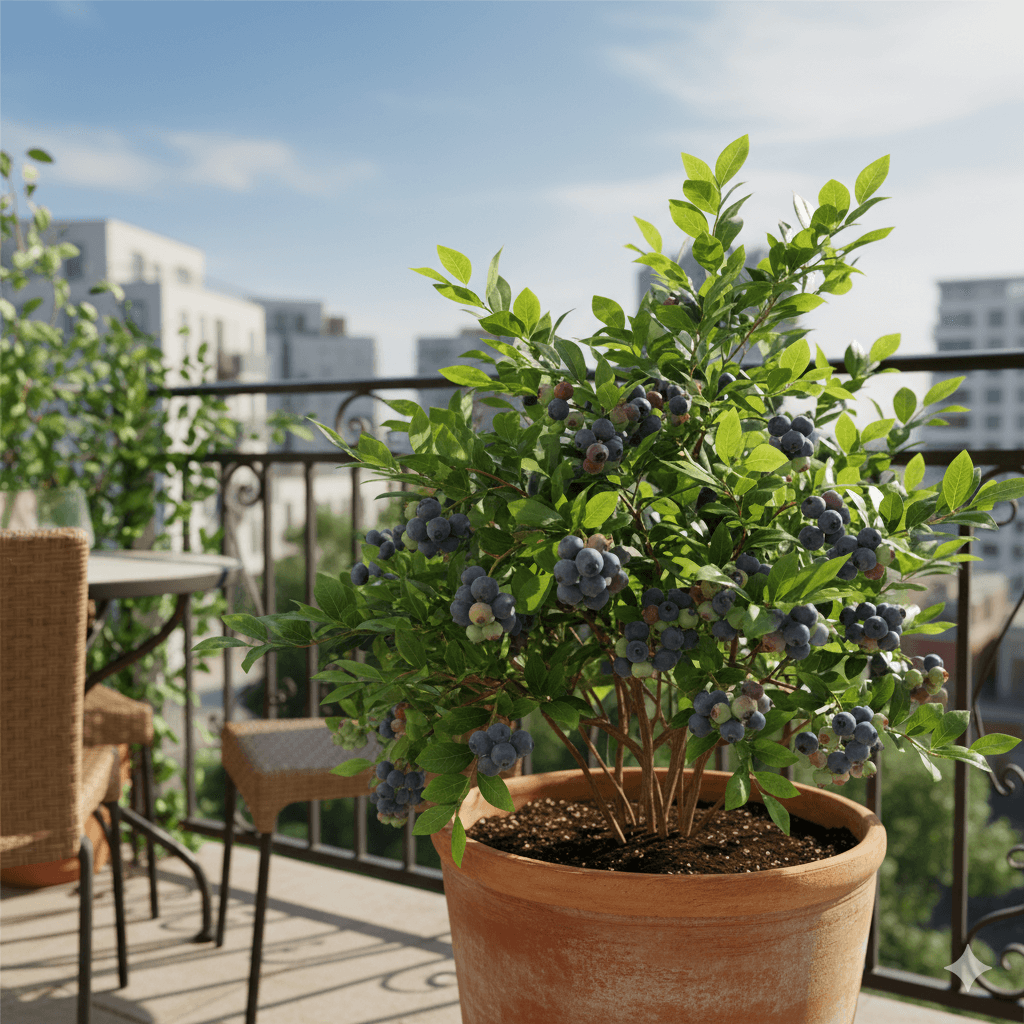
Yes, you can definitely grow blueberries in pots. With the right variety, pot size, acidic soil (pH 4.5–5.5), and consistent care, container blueberries can produce generous harvests for many years. This guide explains why, how, and exactly what to do — backed by practical data and real-world examples.
In This Article
Quick starter: How to grow blueberries in pots — 6 essential steps
- Pick a container — start with 10–15 gallons for most varieties; 5–7 gallons is acceptable for dwarf types.
- Use an acidic potting mix — peat/coir, pine bark, and perlite (recipe below). Maintain pH 4.5–5.5.
- Choose the right variety — dwarfs & half-highs for small spaces; highbush for large containers.
- Place in full sun (6–8 hours) or morning sun + afternoon shade in hot climates.
- Water consistently — keep the soil moist but not waterlogged; use rainwater or softened hard tap water.
- Feed & prune — acidic fertilizer in spring and after fruiting; prune to encourage new fruiting wood.
| Blueberry Variety | Plant Type | Recommended Pot Size | Mature Height | Best Pot Material | Notes / Example |
|---|---|---|---|---|---|
| Top Hat | Dwarf / Half-High | 5–10 gal | 1.5–2 ft | Fabric or Plastic | Great for balconies; example: 16-inch fabric pot yields 2–4 lbs/yr. |
| Jelly Bean | Compact / Patio | 6–10 gal | 2–3 ft | Fabric | Ornamental and tasty; pair with Peach Sorbet for extended harvest. |
| Sunshine Blue | Southern Highbush | 10–18 gal | 2.5–4 ft | Plastic / Resin | Heat tolerant; good in warm regions; morning sun + afternoon shade ideal. |
| Patriot | Northern Highbush | 15–25+ gal | 3–5 ft | Wooden Barrel / Terracotta | Cold hardy; best in large, insulated containers; example: 24″ resin pot works well. |
| Northsky | Half-High | 8–12 gal | 1–2 ft | Fabric | Excellent for very cold climates; use insulated bag in winter. |
Why growing blueberries in pots works (and when it doesn’t)
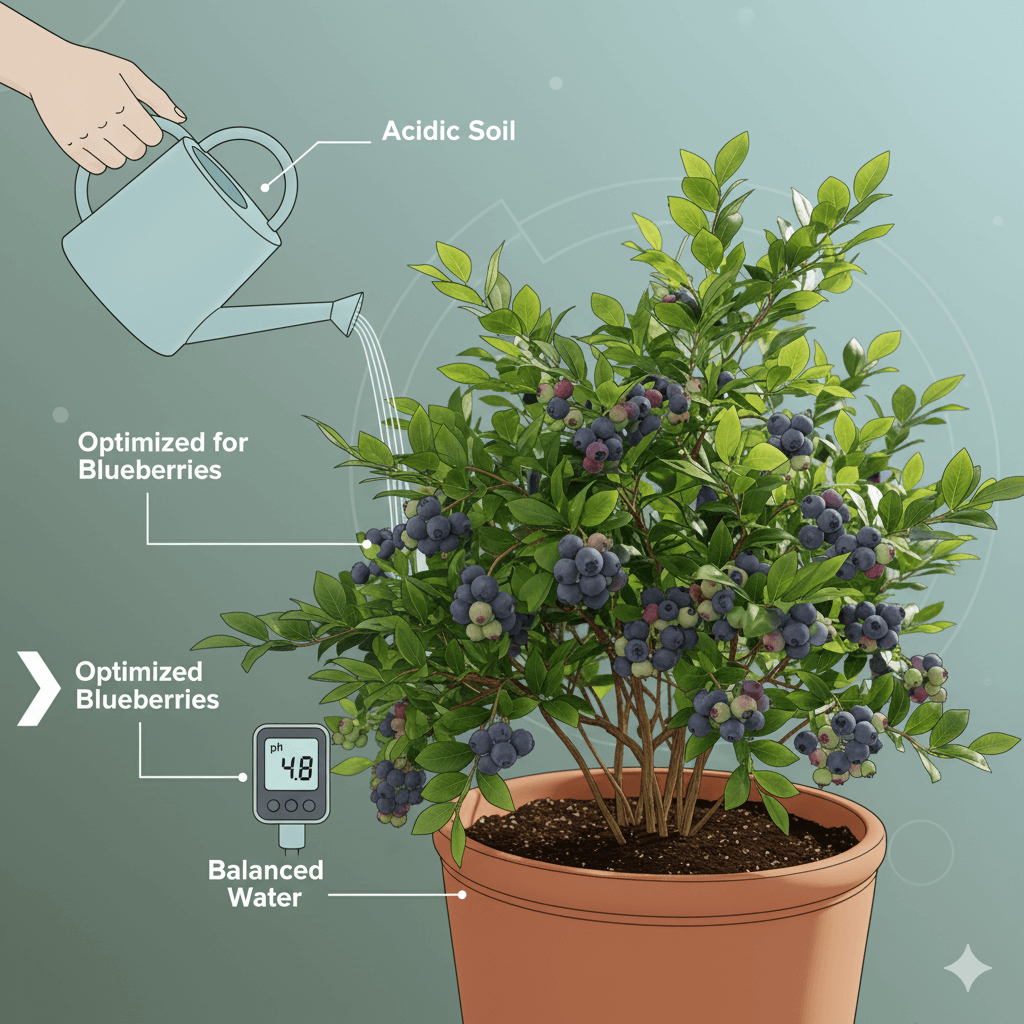
Growing blueberries in containers works because containers allow precise control over three variables that blueberries are sensitive to:
- Soil pH (they prefer acidic soil, pH 4.5–5.5) — easy to control in pots.
- Drainage and aeration — containers let you build a fast-draining, organic-rich media.
- Mobility — pots can be moved for sun, shade, or frost protection.
When it fails: poor pot choice, wrong variety, heavy alkaline water/soil, and inconsistent watering are the main culprits. For example, a blueberry in a 3-gallon pot will likely become root-bound and produce little after year 2 unless repotted.
Key data points to remember
- Optimal pH: 4.5–5.5 (acidic).
- Minimum pot depth: 16–18 inches for mature plants.
- Practical pot volume for most varieties: 10–20 gallons (more for large highbush).
- Repotting frequency: every 2–4 years, depending on growth.
If you haven’t chosen a variety, see “Best Blueberry Varieties for Containers.“
How container pots change root behavior (science + practical takeaways)
Blueberry root systems are fibrous and shallow (major active roots are in the top 8–12 inches of soil but spread laterally). In pots:
- Root restriction increases root density near the pot perimeter — good for small cultivars, but bad when roots circle and choke.
- Soil volume governs available water and nutrients: a general horticultural rule is that every additional gallon of pot volume increases available water/nutrients and lowers daily irrigation frequency.
Practical takeaway: For year-round productive potted blueberries, aim for 10–20 gallons, depending on variety. Smaller pots (5–7 gal) can work for 1–3 years for dwarf bushes, but plan to repot into larger vessels as plants mature.
Which varieties are best in pots — and why (variety × pot recommendation)
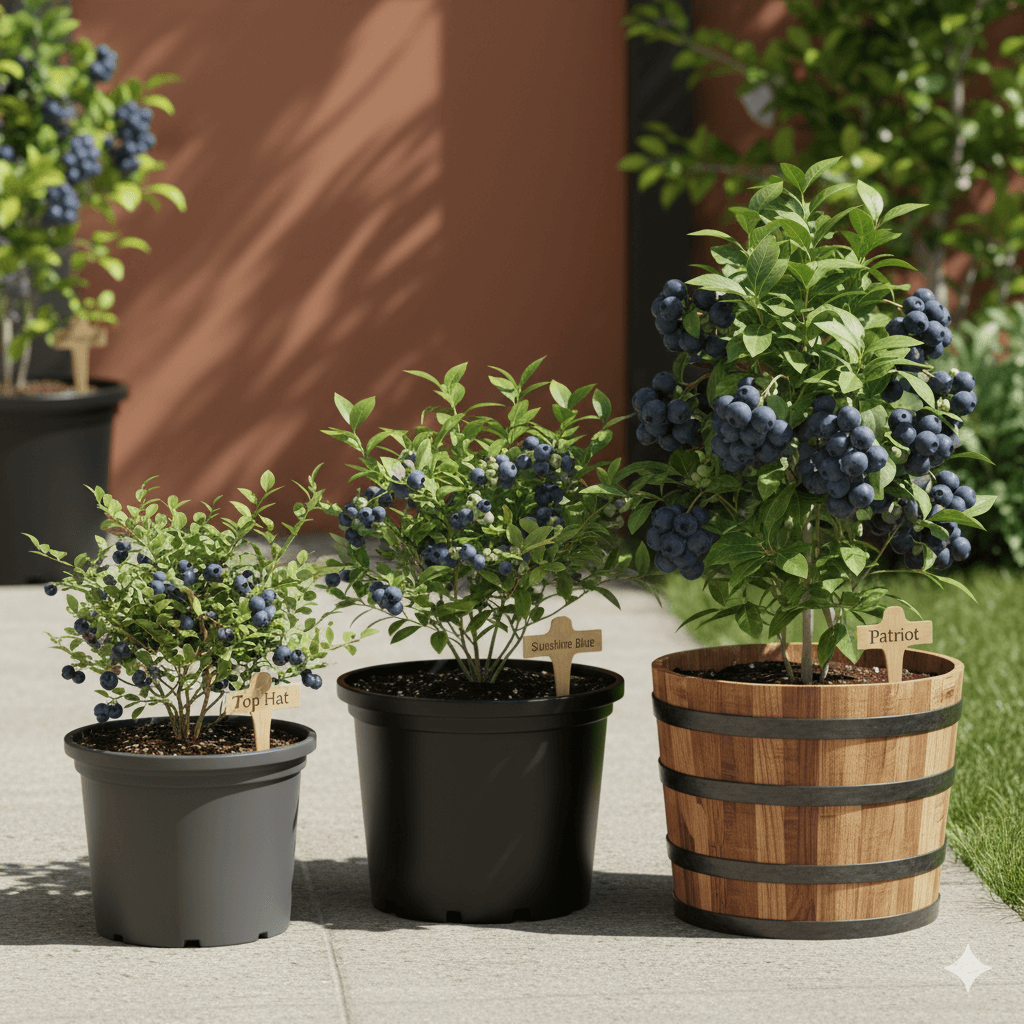
Not all varieties suit container life. Choose plants bred for compact habit, self-fertility, and moderate root demands.
- Dwarf / Half-high types (best for small pots/balconies)
- Examples: Top Hat, Northsky, Jelly Bean
- Pot recommendation: 5–10 gallons (12–16 in diameter) for 1–4 years; upgrade to 10–15 gal for long-term.
- Benefits: compact canopy, cold tolerance (half-high), ornamental value.
- Southern Highbush (good for warmer regions)
- Examples: Sunshine Blue, Misty, Biloxi
- Pot recommendation: 10–20 gallons (18–22 in diameter).
- Benefits: low chill requirement, semi-evergreen in warm climates.
- Northern Highbush (bigger plants — need larger pots)
- Examples: Patriot, Bluecrop, Bluegold
- Pot recommendation: 15–25+ gallons (20–28 in diameter).
- Benefits: large fruit, good cold hardiness; prune and train for pot culture.
Real-world example: A balcony gardener using Top Hat in a 16-inch container often harvests consistent fruit for 4+ years without repotting, while a Bluecrop in the same pot will decline after the first season.
Best pot sizes — exact numbers, why they matter, and airflow implications
Choose a pot size based on the plant’s age, variety, and climate. Below are the practical ranges plus explanations:
- Seedlings / 1st year (establishment): 1–3 gallons — small nursery pots. Use only for starting.
- Young plants (year 2): 5–7 gallons (12–14 in dia) — adequate first production for dwarf varieties.
- Mature plants (years 3–5): 10–15 gallons (16–20 in dia) — stable moisture & nutrient supply for good yields.
- Mature/permanent containers : 20+ gallons (24 in+ dia) — recommended for large highbush varieties or long-term installations.
Why those sizes?
- A 10-15 gal pot contains roughly 1–1.5 cubic feet of soil — enough to buffer daily moisture loss and provide nutrient holding capacity for a mature potted blueberry.
- A 20+ gal pot substantially reduces irrigation frequency and stabilizes root temperature in extremes.
Airflow note: soil in larger pots takes longer to dry; ensure adequate drainage and mix to avoid anaerobic zones.
Best potting materials and how they affect blueberry health
Fabric / grow bags
- Pros: root-pruning, excellent aeration, lighter, reduced circling.
- Cons: dries faster (needs more frequent watering), can degrade over the year.
Plastic/resin pots
- Pros: lightweight, retains moisture, affordable.
- Cons: poor aeration, can overheat in full sun.
Terracotta/clay
- Pros: breathable, attractive, good root temperature moderation.
- Cons: heavy, evaporative, may crack in freeze–thaw climates.
Wooden planters/barrels
- Pros: natural insulation, large volumes available (e.g., whiskey barrels).
- Cons: can rot unless lined; heavier.
Recommendation by climate: use fabric pots in hot/humid regions for aeration and drainage; plastic/resin or wooden barrels in cooler regions where moisture retention and insulation matter.
Soil mixes and pH recipes — exact formulas you can use
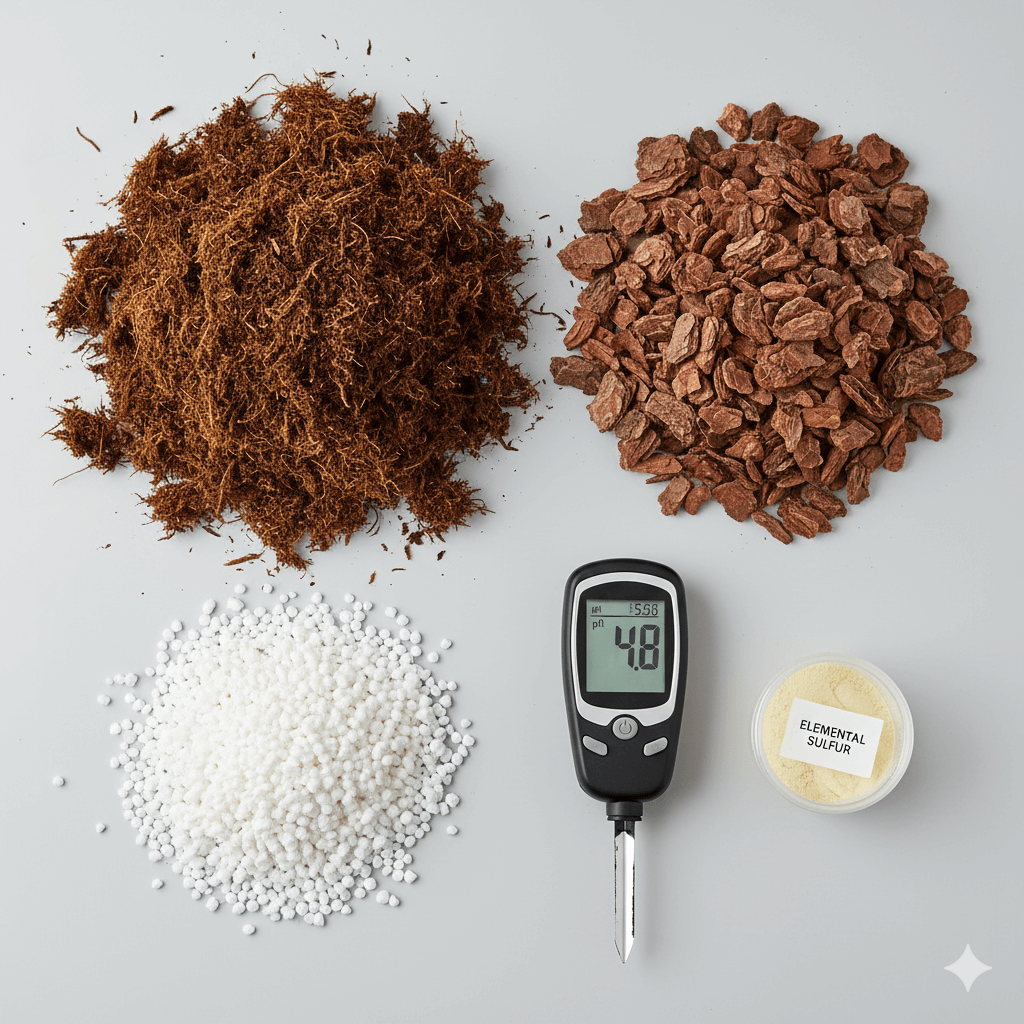
Blueberries NEED acidic, loose, high-organic media. Below are two recipes: one fast-start and one long-term.
Starter mix (1st year/seedlings)
- 40% peat moss or coco coir (coco coir if avoiding peat)
- 30% pine bark fines
- 20% perlite
- 10% composted pine needles or well-rotted compost
Long-term, high-performance mix (for mature plants)
- 35% pine bark fines
- 35% coco coir or sphagnum peat
- 20% perlite or pumice (improves drainage)
- 10% composted leaf mold or well-rotted compost
pH adjustment: Aim for 4.5–5.5. If pH >5.5, add elemental sulfur per manufacturer’s rates (slow acting) or use acidic fertilizer. Test monthly with a digital pH meter or probe. Avoid lime or alkaline amendments.
Watering & irrigation — data, frequency, and best practices
Key rule: Maintain consistently moist but not saturated. Containers dry faster than ground soil.
Guidelines by pot size & climate
- Small pots (5–7 gal) in warm weather: daily watering (morning).
- Medium pots (10–15 gal): water every 2 days in heat; every 3–5 days in cool weather.
- Large pots (20+ gal): water every 3–5 days in heat, less in cooler months.
Method: Water deeply until you see runoff from drainage holes; avoid frequent shallow watering.
Hard water: If your tap water is alkaline, use collected rainwater or distilled water to avoid raising pot pH over time.
Irrigation aids:
- Self-watering planters reduce the risk of under/over watering.
- Drip irrigation with a timer is ideal for multiple pots.
Fertilization, feeding schedule & nutrient specifics
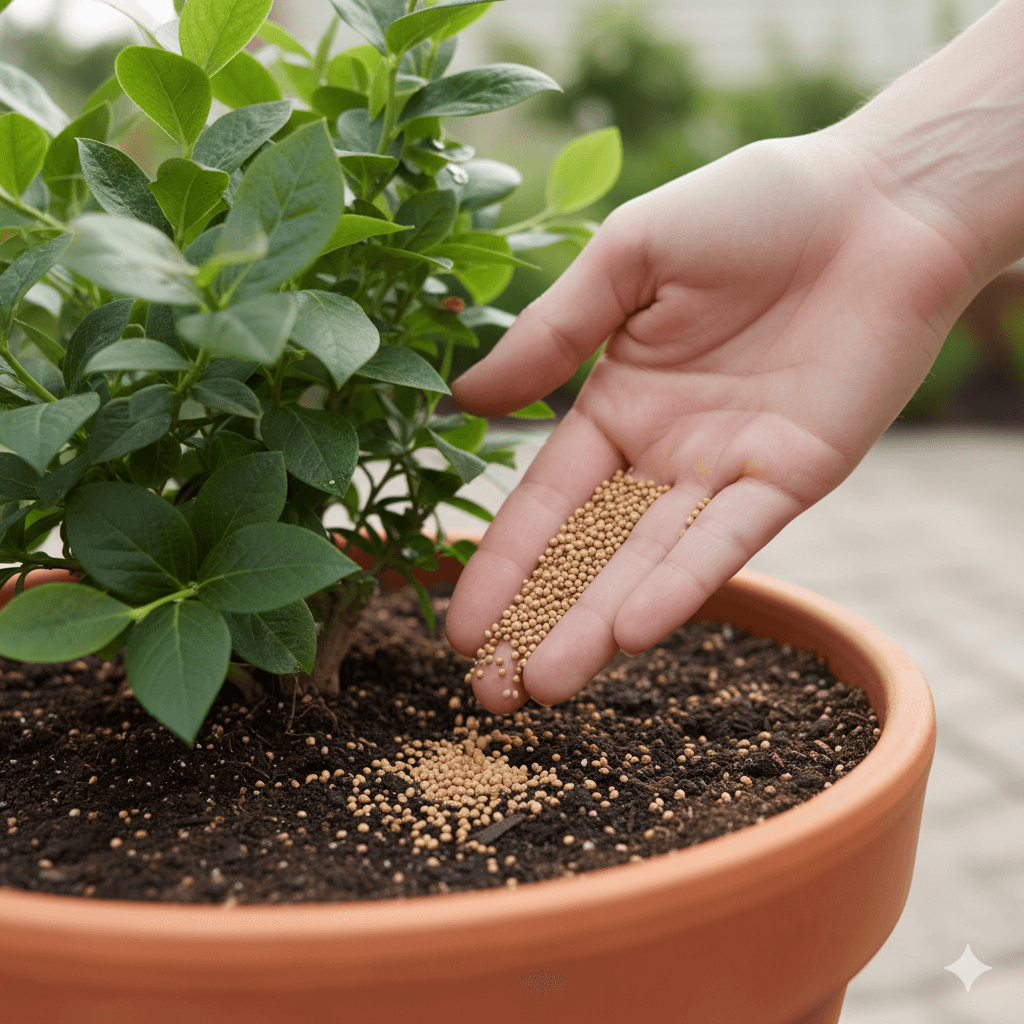
Blueberries respond well to acid-loving plant fertilizers. Avoid high ammonium nitrate style feeding all at once.
Suggested schedule (temperate zones):
- Early spring (before bud break): Apply a slow-release ericaceous fertilizer following label rates.
- After flowering/start of fruit set: apply a balanced liquid acid fertilizer to support fruit growth.
- Mid-summer: lightly top-dress with composted pine bark or organic granular feed.
- Autumn: minimal feeding; focus on plant hardening.
Macro & micro needs: blueberries like ammonium forms of nitrogen over nitrate; they also benefit from chelated iron if leaf chlorosis appears (iron deficiency common in high pH soils).
Pollination, expected yields & timelines in pots
Pollination: Many blueberry cultivars are self-fertile, but cross-pollination with another compatible cultivar usually increases fruit set and berry size.
Time to first fruit:
- Cuttings/transplants often fruit in 1–3 years depending on plant maturity at purchase.
- Potted nursery plants (1–2 years old) typically produce in year 2–3.
Yield expectations (rough, per mature plant in a large pot):
- Dwarf / half-high in 10–15 gal: 2–6 lbs/year
- Mid-size, 15–20 gal: 4–8 lbs/year
- Large highbush 20+ gal: 6–12+ lbs/year
Repotting & root care — when and how (step-by-step)
When to repotting
- Roots visible through drainage holes.
- Soil dries out immediately after watering.
- Reduced flowering/fruiting despite correct care.
Repotting steps (best done in early spring)
- Prepare a new pot — 2–4 inches larger diameter than current. Add the fresh acidic mix.
- Remove plant gently — tap sides, slide out.
- Inspect roots — prune circling roots lightly; don’t over-prune.
- Place plant at same soil depth; fill with fresh mix; firm lightly.
- Water thoroughly to settle the soil and reduce air pockets.
- Mulch with pine needles to conserve moisture and add acidity.
Pro tip: Repot gradually — one pot size at a time, unless the root ball strongly constrains plant.
Troubleshooting: common problems & quick fixes
Yellow leaves/chlorosis
- Likely pH is too high; test soil. Apply sulfur or iron chelate as needed. Use rainwater if tap is alkaline.
Small berries or few berries
- Causes: insufficient chill hours, inadequate pollination, pruning mistakes, or nutrient imbalance. Cross-pollinate with a compatible variety and review pruning schedule.
Root rot / wilting
- Poor drainage or oversized pot with heavy mix. Remedy: repot into airy mix, improve drainage, use fabric pots to promote aeration.
Pests
- Birds love blueberries; use netting. Aphids or mites: use insecticidal soap or neem oil during non-bloom periods.
Climate-specific adjustments (cold / temperate / hot & humid / tropical)
Cold climates (USDA 3–6)
- Choose cold-hardy varieties (Patriot, Northblue).
- Use insulated pots or cluster pots against a south-facing wall.
- Mulch heavily in winter. Consider moving pots to an unheated garage during deepest freezes.
Temperate climates (USDA 6–8)
- Standard potting approaches work well. Use morning sun with afternoon shade in very hot summers.
Hot & humid climates (USDA 8–10)
- Use fabric pots for aeration and elevated stands to improve airflow.
- Provide afternoon shade and use self-watering containers to stabilize moisture.
Tropical
- Select low chill cultivars (Southern Highbush) and shade cloth for peak heat. Monitor for fungal disease due to humidity.
Long-term maintenance & maximizing plant life (years 4–12+)
- Annual pruning: remove 1–2 older canes to stimulate new fruiting wood.
- Refresh topsoil each spring with fresh acidic mix or composted pine bark.
- Repot every 2–4 years depending on container and growth.
- Record keeping: track pH, fertilization, and yields to spot trends and improve performance.
FAQ – Can You Grow Blueberries in Pots
Can you grow blueberries in pots year-round?
Yes. With proper winter protection in cold zones or container cooling/shade in hot zones, blueberries can live and fruit year-round in pots.
What size pot do blueberries need?
For long-term success, 10–20 gallons is a practical range for most container blueberries; 5–7 gallons works only for very small dwarfs or temporary use.
How acidic should the soil be?
Aim for pH 4.5–5.5. Test regularly and amend with sulfur or ericaceous fertilizer as needed.
How often do potted blueberries need repotting?
Generally, every 2–4 years, depending on growth and pot size.
Conclusion
Yes, you can grow blueberries in pots successfully. The recipe for success is simple in concept and actionable in practice: right variety + correct pot size + acidic, airy soil + consistent moisture + seasonal care. Follow the steps above, link your decisions to the variety you choose, and you’ll be enjoying fresh berries from your balcony or patio for over the year.