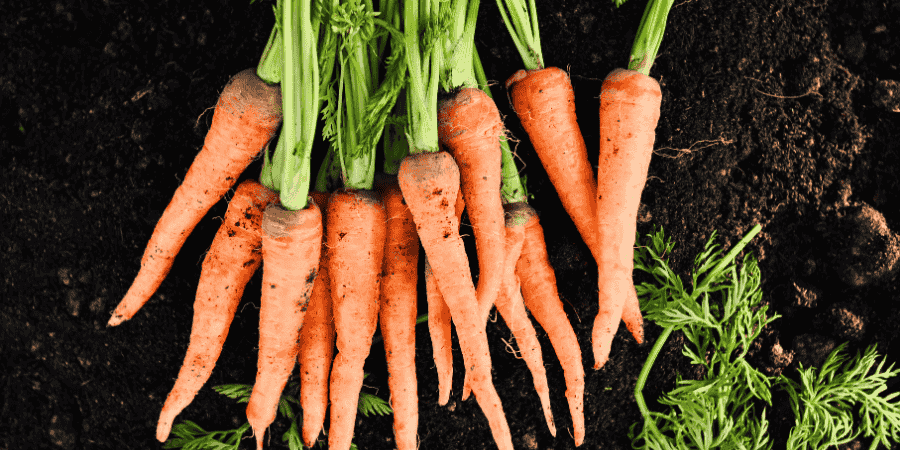
Have you ever wanted to growing carrots in Georgia? It’s easier than you might think! In this guide, we’ll walk you through how to grow carrots in Georgia, from choosing the right types to harvesting your crop.
You’ll learn how to grow carrots in containers, from seed, and even in the winter.
In 2020, Georgia grew over 1,200 acres of carrots worth about $14.4 million.
That’s a lot of carrots! You can add to Georgia’s carrot production as a home gardener while enjoying fresh carrots.
Quick Checklist – Growing Carrots in Georgia
- Test and adjust soil pH (5.8–6.8).
- Loosen and amend clay to at least 8–12″ depth or use raised beds.
- Select a short-type variety for heavy soils.
- Sow in cool windows: late winter/early spring and late summer/early fall.
- Keep soil consistently moist until germination, and thin seedlings to 2–3″.
- Use mulch and row covers to conserve moisture and block pests.
Why Carrots are a Great Choice for Georgia Gardens
Carrots are one of the most rewarding vegetables for home gardeners: nutritious, versatile in the kitchen, and surprisingly sweet when grown under the right conditions.
In Georgia, the combination of warm days and cooler nights (in many seasons) can enhance carrot flavor — but the state’s range of soils and late-summer heat also creates unique challenges.
This guide is written specifically for backyard and home gardeners in Georgia. You’ll find region-specific planting windows, soil solutions for Georgia’s red clay, trusted carrot varieties, and practical step-by-step instructions to increase germination, root size, and flavor.
Whether you’ve never grown carrots before or you want to stop producing tiny, forked roots, this guide gives the exact techniques that work in Georgia gardens.
Related: Growing Carrots in Texas (Zones 6a-7b): An Expert Guide for Small Gardens
Choosing Carrot Types for Georgia
- When picking carrot types for Georgia, look for ones that grow well in the state’s climate. Some good options are:
- Danvers Half Long: A tough type that grows 7-inch long carrots.
- Nantes: Known for being sweet and crunchy, great for Georgia’s clay soil.
- Little Finger: A small, tender type perfect for containers or early harvests.
- Buy carrot seeds from trusted places, like:
- Johnny’s Selected Seeds
- Burpee
- Baker Creek Heirloom Seeds
- Think about when the carrots will be ready, how big they’ll get, and what color they are. Check out this table comparing some popular types:
| Variety | Shape/Size | Days to Maturity | Best For |
| Scarlet Nantes | Medium, cylindrical | 60–75 | Sweet, tender; great for fresh eating |
| Danvers 126 | Tapered, strong root | 70–80 | Tolerates heavier soils; good all-purpose |
| Royal Chantenay | Short, stout | 70–80 | Works well in shallow or clay soils |
| Little Finger | Short, slender | 55–65 | Baby carrots and containers |
| Napoli / Mokum | Long, sweet | 70–85 | Long roots; deep, loose soils |
Tip: If your garden has heavy clay, prioritize shorter, stumpier varieties (Royal Chantenay, Danvers) rather than long, slender types that require deep, stone-free soil.
For winter growing in Georgia, choose types that can handle the cold, like Napoli or Mokum. For containers, go with shorter types like Little Finger or Parisian.
The Georgia Vegetable Team says home gardeners should choose types based on how and when they want to grow them.
Bolero and Sugarsnax 54 are good choices for fall planting and winter harvest since they can handle cool temperatures. Shorter types like Chantenay or Royal Chantenay are less likely to grow crooked in heavy clay soil.
Related: Growing Carrots in Oklahoma: A Complete Guide for Success
Getting Your Carrot Bed Ready
- Carrots do best in loose soil that drains well, with a pH between 5.8 and 6.8. To prep your soil:
- Remove rocks, sticks, and trash that could get in the way of the carrot roots.
- Mix up the soil to at least 12 inches deep to keep it from being too packed.
- Mix in compost or aged manure to make the soil richer.
- Pick a spot that gets full sun for at least 6-8 hours a day. Don’t plant carrots near trees or bushes, as they’ll compete for food and water.
- If you have limited space or heavy clay soil, consider growing carrots in containers or raised beds.
- Use containers at least 12 inches deep with drain holes.
- Fill them with a potting mix made for veggies.
- Make raised beds at least 12 inches deep, filled with a mix of soil and compost.
Ensure your carrot bed is free of rocks and things that could make the carrots grow weird. If using containers, pick a light potting mix that drains well so the roots don’t get too wet and rot.
You can also add mulch around your carrots to help keep moisture in and protect the soil.
A University of Georgia study found that carrots grown in loose, well-prepped soil made more and better carrots than those in packed or poorly prepped soil.
They say to mix in 2-3 inches of compost or aged manure before planting for the best results.
When to Plant Carrots in Georgia (By Region)
Carrots are a cool-season crop. In Georgia, that generally means planting in early spring and again in late summer/early fall for cooler-season harvests. Exact timing depends on your location.
- North Georgia (mountains & upper piedmont):
- Spring: Late February – March (as early as soil can be worked and is around 50–60°F).
- Fall: Late July – early September for a fall/winter crop; plant early enough to avoid the hottest midsummer weeks.
- Central Georgia (piedmont & midlands):
- Spring: Late February – mid-March.
- Fall: Mid-August – late September.
- South Georgia (coastal plain):
- Spring planting is riskier because heat arrives earlier; prefer fall planting (October) for sweet winter carrots.
Planting windows: aim for soil temperatures between 50°F and 75°F. Carrot seed germination slows when soil gets hotter than ~75°F.
Preparing Georgia Clay Soil (Make It Root-Friendly)
Georgia’s red clay is the most common soil complaint. Clay compacts, forms hard clods, and causes forked or stunted carrots. Fix it before planting.
Soil prep steps:
- Test your soil pH. Carrots prefer pH 5.8–6.8. If you need to adjust, do it well before planting.
- Create loose, deep rooting medium. For in-ground rows, loosen soil 10–12 inches deep, removing stones and rocks. For best results, build raised beds (6–12 inches of loose mix). See our guide to raised beds for vegetables for how-to steps.
- Add coarse organic matter and sand sparingly. Mix in 4–6 inches of compost and, only if needed, coarse sand or screened topsoil to break up clay. Avoid adding too much fine sand on its own — that can make a concrete-like mix.
- Avoid fresh high-nitrogen manure right before planting. It can cause forked roots and hairy carrots. Well-composted organic matter is best. Learn more in our soil amendment guide.
- Consider containers or deep raised beds if your garden soil is especially heavy — carrots love the friable mix.
Quick fix: If you don’t have time for a deep soil overhaul, grow short-type carrots in wide bands or containers filled with a loamy potting mix. They’ll perform far better than in compacted clay.
Planting Steps — From Seed to Sprout
Carrots are nearly always direct-sown (not transplanted), because root disturbance hurts formation.
How to plant (step-by-step):
- Choose the site. Full sun for best root development (6–8+ hours). Partial shade can work but expect slower growth.
- Prepare rows or wide bands. Rows 12–18 inches apart allow access for thinning. For band sowing, scatter seeds across a 2–3 inch band.
- Sow seed depth. Cover carrot seed very lightly — 1/8 to 1/4 inch (¼” max). Tiny seeds need light-level cover.
- Spacing and thinning plan. Aim for final spacing of 2–3 inches between roots. Sow more densely and plan to thin (use scissors to snip extras at soil level to avoid disturbing roots).
- Firm the seedbed. Lightly tamp soil after sowing to ensure good seed-soil contact. Cover with straw or burlap temporarily in very hot or windy conditions to retain moisture.
- Water gently. Keep soil consistently moist until germination (10–21 days depending on temp). After sprouting, water deeply and less frequently to encourage root growth.
Germination tip: If germination is poor in hot weather, try pre-soaking seeds for 12–24 hours or mix seeds with sand to help spread them evenly. Covering rows with floating row cover can retain moisture and protect seedbeds from carrot flies.
Planting Your Carrots
- The best time to plant carrots in Georgia is early September to mid-November for winter harvests and early January to mid-March for spring harvests. Check out these planting dates:
| Planting Time | Harvest Time |
| September | December – January |
| October | January – February |
| November | February – March |
| January | April – May |
| February | May – June |
| March | June – July |
- To plant your carrot seeds:
- Make shallow rows about 1/4 inch deep in your prepped soil.
- Sprinkle the seeds thinly, aiming for 2-3 seeds per inch.
- Cover the seeds with a thin layer of soil and pat it down gently.
- Water well, and keep the soil damp until the seeds sprout.
- When the baby carrots are about 2 inches tall, thin them 2-3 inches apart; this gives each carrot room to grow.
- Plant new carrot seeds every 2-3 weeks during the growing season to get a longer harvest.
When growing carrots from carrot seeds in Georgia, keep the soil damp until the seeds sprout, which can take up to 2 weeks. As the baby carrots rise, slowly water less often while keeping the soil moist. If growing carrots in winter, be ready to cover them if there’s a frost coming.
The Georgia Vegetable Team recommends planting carrot seeds 1/4 to 1/2 inch deep, 1-2 inches apart when they’re 2 inches tall, and thin them to 2-3 inches apart; for a longer harvest, plant every 2-3 weeks.
Care & Maintenance — Thinning, Watering, Fertilizing, and Pests
Thinning: This is probably the single most important step for a good carrot crop. Thin when seedlings reach 2 inches tall to 2–3 inches apart. Crowded carrots produce skinny roots.
Watering: Carrots need consistent moisture. Aim for roughly 1 inch per week, more in sandy soils or hot periods. Avoid letting the soil dry out between waterings — that causes split roots and poor flavor.
Fertilizing: Feed lightly. Carrots prefer low nitrogen, higher potassium and phosphorus. Too much nitrogen produces lots of foliage and misshapen roots. Consider a balanced organic fertilizer or a side-dressing when plants are 4–6 weeks old.
Mulching: Apply 2–3 inches of straw or shredded leaves after seedlings are established. Mulch conserves moisture, suppresses weeds, and stabilizes soil temperature.
Pests & disease control:
- Carrot rust fly: Use floating row covers during susceptible periods and rotate crops yearly.
- Cutworms and wireworms: Keep beds weeded and remove plant debris that attracts pests.
- Root knot nematodes: Rotate with non-host crops and consider soil solarization or resistant varieties in problem beds.
- Aphids / foliage pests: Encourage beneficial predators (ladybugs) or use insecticidal soap if needed.
For region-specific pest timing and advice, consult the UGA Cooperative Extension resources.
Harvesting and Storing Carrots Georgia
- Carrots are usually ready to pick 60-80 days after planting, depending on the type. Signs they’re ready are:
- Carrot Tops are 6-8 inches tall.
- Roots are the size you want for that type.
- They resist a bit if you tug gently on the top.
- To harvest your carrots:
- Loosen the soil around them with a garden fork.
- Pull them out gently so you don’t break the roots.
- Brush any extra soil and twist off the tops, leaving 1/2 inch of stem.
- Before storing, pull out any carrots that are messed up or sick. Wash the carrots well and let them fully air dry.
- Store your carrots somewhere cool and humid, like the fridge or a root cellar.
- Please put them in a bag with holes or wrap them in a damp paper towel to keep humidity in.
- Stored right, they can last 2-3 months.
Be gentle when harvesting so you don’t bruise or break the carrots. If growing them in Georgia in winter, you might need to harvest before the first hard frost so it doesn’t damage the roots.
If you want to store them for a long time, use a root cellar or another cool, humid spot to keep them fresh.
The University of Georgia Extension says Georgia gardeners can expect 1-2 pounds of carrots per foot of row, but it varies by type and how you grow them.
Harvest when the roots are the size they should be for the type—3 inches for baby carrots up to 8 inches for big ones. To make them last as long as possible, store harvested carrots in the fridge or root cellar at 32-40°F and 90-95% humidity.
FAQ from Georgia Gardeners
Q: Why are my carrots small and forked?
A: Likely causes: compacted or rocky soil, crowding (didn’t thin), or inconsistent moisture. Remedy: grow carrots in looser soil (raised beds/containers), thin to 2–3″, and keep water even.
Q: My seeds didn’t germinate — what to do?
A: Carrot seeds are tiny and need cool, moist soil to sprout. Keep the seedbed consistently moist for up to 3 weeks. Consider pre-soaking seeds, sowing with sand for even distribution, and covering lightly with straw or burlap to retain moisture.
Q: Can I grow carrots in partial shade?
A: Yes, but expect slower growth and possibly smaller roots. If shade is unavoidable, pick shorter varieties and accept reduced yields.
Q: When should I plant to avoid Georgia heat?
A: For a fall crop, aim for mid-August to early September in central Georgia; October works well in south Georgia. The goal is to have the roots form during cooler nights and avoid midsummer high soil temps.
Q: How do I prevent carrot flies?
A: Use row covers during egg-laying periods, practice crop rotation, and avoid leaving large areas of host crops near the garden. Carrot flies are most active during cooler parts of the season at dawn and dusk.
Conclusion:
Growing carrots in Georgia is simple — when you match variety to soil, plant in the correct window for your region, and focus on loose soil plus consistent moisture.
With the steps above you’ll move from frustrating tiny roots to crisp, sweet carrots your family will love. If you want, I can convert this into a printable one-page checklist and a region-specific planting calendar tailored to your county — would you like me to do that next?